Demineralization (DM) Water Plant
High-purity deionized water for industrial and laboratory applications
Producing ultra-pure water with conductivity as low as 0.1 µS/cm through advanced ion exchange technology
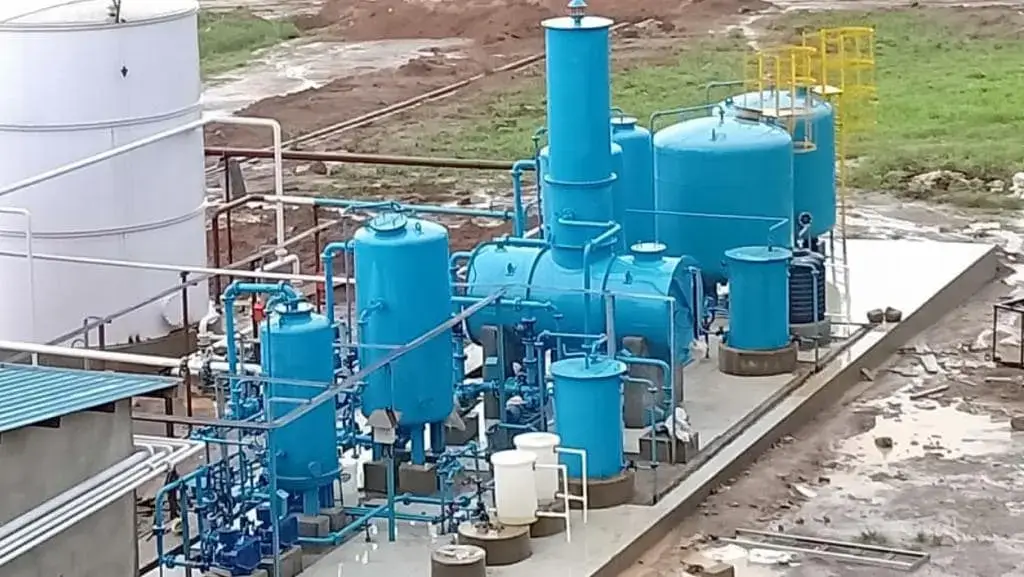
What is a Demineralization Plant?
Complete ion exchange technology for ultra-pure water production
A Demineralization (DM) Plant is an advanced water treatment system that removes mineral salts and ions from water through an ion exchange process. It produces high-purity water with conductivity ranging from 0.1 to 5 µS/cm by exchanging mineral ions with hydrogen and hydroxyl ions.
The system operates using cation and anion exchange resins. Cation resins exchange positive ions (Ca²⁺, Mg²⁺, Na⁺) with H⁺ ions, while anion resins exchange negative ions (Cl⁻, SO₄²⁻, HCO₃⁻) with OH⁻ ions. The combination produces chemically pure H₂O.
DM plants are essential for industries requiring ultra-pure water such as power plants, pharmaceuticals, electronics manufacturing, laboratories, and high-pressure boilers where mineral-free water prevents scaling, corrosion, and product contamination.
Our DM plants feature automatic regeneration systems, PLC-based controls, and high-efficiency ion exchange resins for optimal performance with minimal operational intervention.
Ion Exchange Technology
Cation & anion resin beds for complete demineralization
High-Purity Output
Produces water with conductivity <5 µS/cm, silica <0.02 ppm
Industrial Applications
For power plants, pharma, electronics, laboratories
Regenerable System
Resins regenerated 1000+ times with acid & alkali
Ion Exchange Process
How DM plants remove mineral ions from water
Cation Exchange
Ca²⁺, Mg²⁺ → H⁺
Anion Exchange
Cl⁻, SO₄²⁻ → OH⁻
Pure Water
H⁺ + OH⁻ → H₂O
Key Benefits of DM Plants
Advantages over other water purification methods
Ultra-Pure Water Quality
Produces water with conductivity as low as 0.1 µS/cm, silica <0.02 ppm, meeting pharmacopoeia standards for purified water.
Fully Automated Operation
PLC-based automation for regeneration, backwash, and service cycles. Touchscreen interface with data logging capabilities.
Cost Effective Operation
Lower operational cost compared to RO+EDI systems for high purity requirements. Regenerable resins last 3-5 years.
Regenerable Resin System
Ion exchange resins can be regenerated 1000+ times with acid (HCl/H₂SO₄) and alkali (NaOH) solutions.
High Flow Rate Capacity
Can handle high flow rates up to 1,00,000 LPH efficiently. Suitable for large industrial applications.
Corrosion & Scaling Prevention
Eliminates scaling and corrosion in boilers, heat exchangers, and cooling systems by removing all mineral ions.
Types of DM Plants
Choose the right configuration for your application
Most common configuration - Separate cation and anion vessels. Produces water with 5-10 µS/cm conductivity.
Best for: General industrial use Output: 5-10 µS/cmUltra-high purity - Cation & anion resins mixed together. Produces water with <0.1 µS/cm conductivity.
Best for: Pharma, electronics Output: <0.1 µS/cmCost-effective for high TDS - RO pretreatment reduces DM plant load and regeneration frequency by 70%.
Best for: High TDS water Savings: 40-60% chemicalsUltra-high purity requirements - Multiple mixed-bed units in series for semiconductor and microelectronics industry.
Best for: Semiconductor Output: 0.055 µS/cmTechnical Specifications
Complete specifications for our DM plant systems
Strong Base Anion (SBA): Tulsion A-72, Amberlite IRA-400
Mixed Bed: Tulsion MB-10, Amberlite MB-20
Anion: NaOH (4-8%)
Dosing: Automatic proportional dosing pumps
Industrial Applications
Where DM plants are essential for operations
Power Plants
High-pressure boiler feed water, turbine cooling, makeup water
Pharmaceuticals
WFI (Water for Injection), purified water systems, formulation
Electronics Manufacturing
Wafer washing, semiconductor production, PCB manufacturing
Laboratories & Research
Analytical grade water, research facilities, testing labs
Chemical Industry
Process water, reaction media, catalyst preparation
Oil & Gas
Boiler feed water, enhanced oil recovery, refinery processes
DM Plant Components
High-quality components for reliable operation
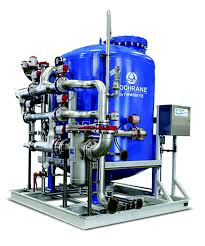
Ion Exchange Vessels
Pressure vessels for cation & anion resin beds
- Sizes: 12" to 96" diameter
- FRP/MSRL/SS construction
- Designed for 3-6 kg/cm² pressure
- ASME coded design available
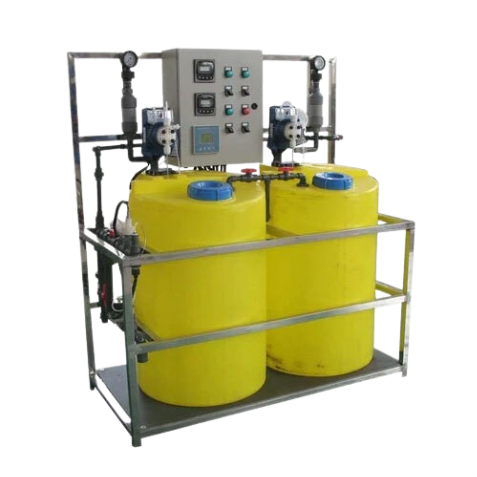
Chemical Dosing System
For resin regeneration with acid & alkali
- Acid (HCl/H₂SO₄) dosing
- Caustic (NaOH) dosing
- Proportional dosing pumps
- Chemical storage tanks
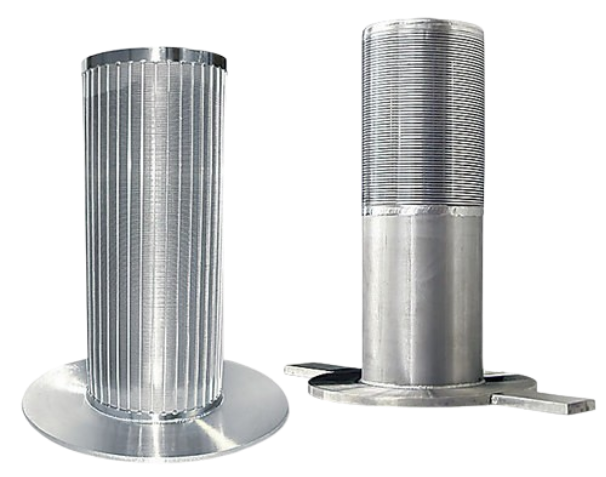
Resin Traps & Strainers
Prevents resin leakage from vessels
- SS 304/316 construction
- 50-100 mesh screens
- Quick-release design
- Differential pressure gauge
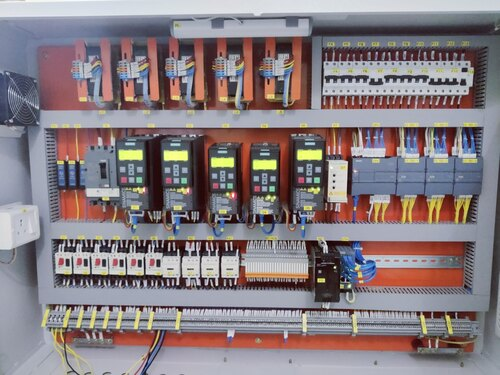
PLC Control Panel
Automated operation & monitoring system
- Siemens/Allen Bradley PLC
- Conductivity & pH meters
- Touchscreen HMI interface
- Data logging & alarms
Regeneration Process
5-step automatic regeneration cycle
Backwash
Upset resin bed to remove suspended solids and fines
Duration: 10-15 minutesChemical Injection
Inject acid (cation) or alkali (anion) for regeneration
Conc: 4-8% solutionSlow Rinse
Displace chemicals through resin bed at low flow
Duration: 30-45 minutesFast Rinse
Rinse at service flow until conductivity meets spec
Target: <5 µS/cmReturn to Service
Automatically switch back to normal operation mode
Ready for productionCation Regeneration
Chemicals: Hydrochloric Acid (HCl) or Sulfuric Acid (H₂SO₄)
Concentration: 4-7% HCl or 1-2% H₂SO₄
Consumption: 40-60 gms HCl per liter resin
CorrosiveAnion Regeneration
Chemical: Sodium Hydroxide (NaOH)
Concentration: 4-8% solution
Consumption: 60-80 gms NaOH per liter resin
CausticWater Quality Standards
Industry-specific water quality requirements
| Parameter | Two-Bed DM | Mixed-Bed DM | Pharma Grade (USP) | Boiler Feed Water |
|---|---|---|---|---|
| Conductivity (µS/cm) | 5-10 | <0.1 | <1.3 @ 25°C | <0.1 |
| pH Value | 7-8 | 6.5-7.5 | 5.0-7.0 | 8.8-9.2 |
| Silica (SiO₂) | 0.1-0.5 ppm | <0.02 ppm | NA | <0.02 ppm |
| Hardness | 0 ppm | 0 ppm | NA | 0 ppm |
| TOC | <0.5 ppm | <0.1 ppm | <500 ppb | NA |
| Bacteria (CFU/ml) | <100 | <10 | <100 | Sterile |
DM Plant vs RO System
Choosing the right technology for your application
| Parameter | DM Plant | RO System | Recommended For |
|---|---|---|---|
| Water Purity | Higher (0.1-5 µS/cm) | Lower (10-50 µS/cm) | DM for ultra-pure, RO for general |
| Silica Removal | Excellent (<0.02 ppm) | Limited (1-5 ppm) | DM for boiler feed water |
| Chemical Usage | High (acids & alkalis) | Low (antiscalants only) | RO for minimal chemical use |
| Capital Cost | Higher for same capacity | Lower initial investment | RO for budget constraints |
| Operating Cost | Higher (chemical costs) | Lower (mainly electricity) | RO for lower OPEX |
| Space Requirement | More space needed | Compact design | RO for space constraints |
| Best Application | Power plants, pharma, electronics | Drinking water, general industry | Choose based on purity needs |
Recommendation:
For TDS <500 ppm and ultra-pure requirements:
Use DM Plant
For TDS >500 ppm and general purification: Use
RO System
For TDS >1000 ppm and high purity: Use RO + DM
Hybrid System
Frequently Asked Questions
Common questions about DM plants answered
RO (Reverse Osmosis) uses semi-permeable membranes to physically filter dissolved solids, achieving 95-98% rejection. Output conductivity is typically 10-50 µS/cm.
DM (Demineralization) uses ion exchange resins to chemically remove mineral ions, achieving near-complete removal. Output conductivity is 0.1-5 µS/cm.
Key difference: DM produces higher purity water but requires chemical regeneration. RO is better for bulk TDS reduction without chemicals.
Regeneration frequency depends on:
- Water quality: Higher TDS = more frequent regeneration
- Plant capacity: Higher flow = faster resin exhaustion
- Resin type: Different resins have different capacities
Typical frequencies:
• Cation resins: Every 8-24 hours
• Anion resins: Every 12-48 hours
• Mixed bed: Every 1-4 weeks
The plant automatically initiates regeneration when conductivity reaches setpoint (usually 5-10 µS/cm).
For cation resin regeneration:
• Hydrochloric Acid (HCl) - 4-7% concentration
• Sulfuric Acid (H₂SO₄) - 1-2% concentration
Consumption: 40-60 grams HCl per liter of resin
For anion resin regeneration:
• Sodium Hydroxide (NaOH) - 4-8% concentration
Consumption: 60-80 grams NaOH per liter of resin
Safety: Both chemicals are hazardous. Proper PPE, ventilation, and neutralization systems are mandatory. We provide complete chemical handling systems.
DM plants can handle TDS up to 500 ppm efficiently. Beyond this, pretreatment is recommended:
- 500-1000 ppm: Softener + DM plant
- 1000-2000 ppm: RO + DM plant (hybrid)
- Above 2000 ppm: RO essential before DM
Why pretreatment?
1. Reduces chemical consumption by 60-80%
2. Extends resin life by 2-3 times
3. Reduces regeneration frequency
4. Lowers operating costs significantly
Daily/Weekly:
• Check chemical levels in storage tanks
• Monitor conductivity and pH readings
• Verify automatic valve operation
• Check for resin leakage
Monthly:
• Calibrate conductivity and pH probes
• Inspect pump seals and valves
• Clean resin traps and strainers
• Check control panel operation
Annual/As needed:
• Resin replacement (every 3-5 years)
• Chemical cleaning of fouled resins
• Complete system overhaul
• Resin capacity testing
We provide comprehensive AMC (Annual Maintenance Contract) covering all maintenance needs.
DM PLANT ENQUIRY
Get customized quotation and technical specifications
Water Treatment Experts
+91 97116 23131
info@kdstechnologies.in